
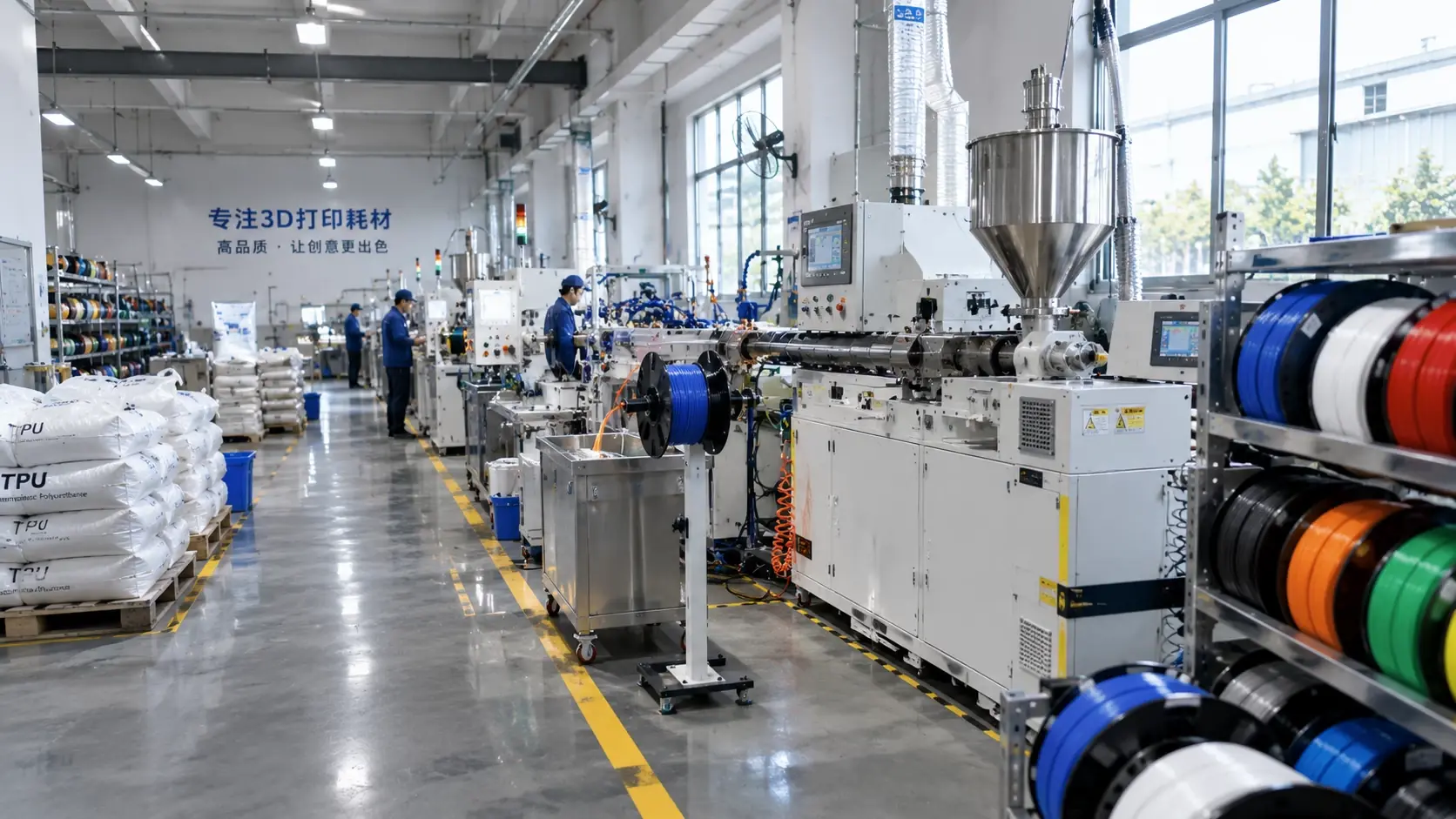
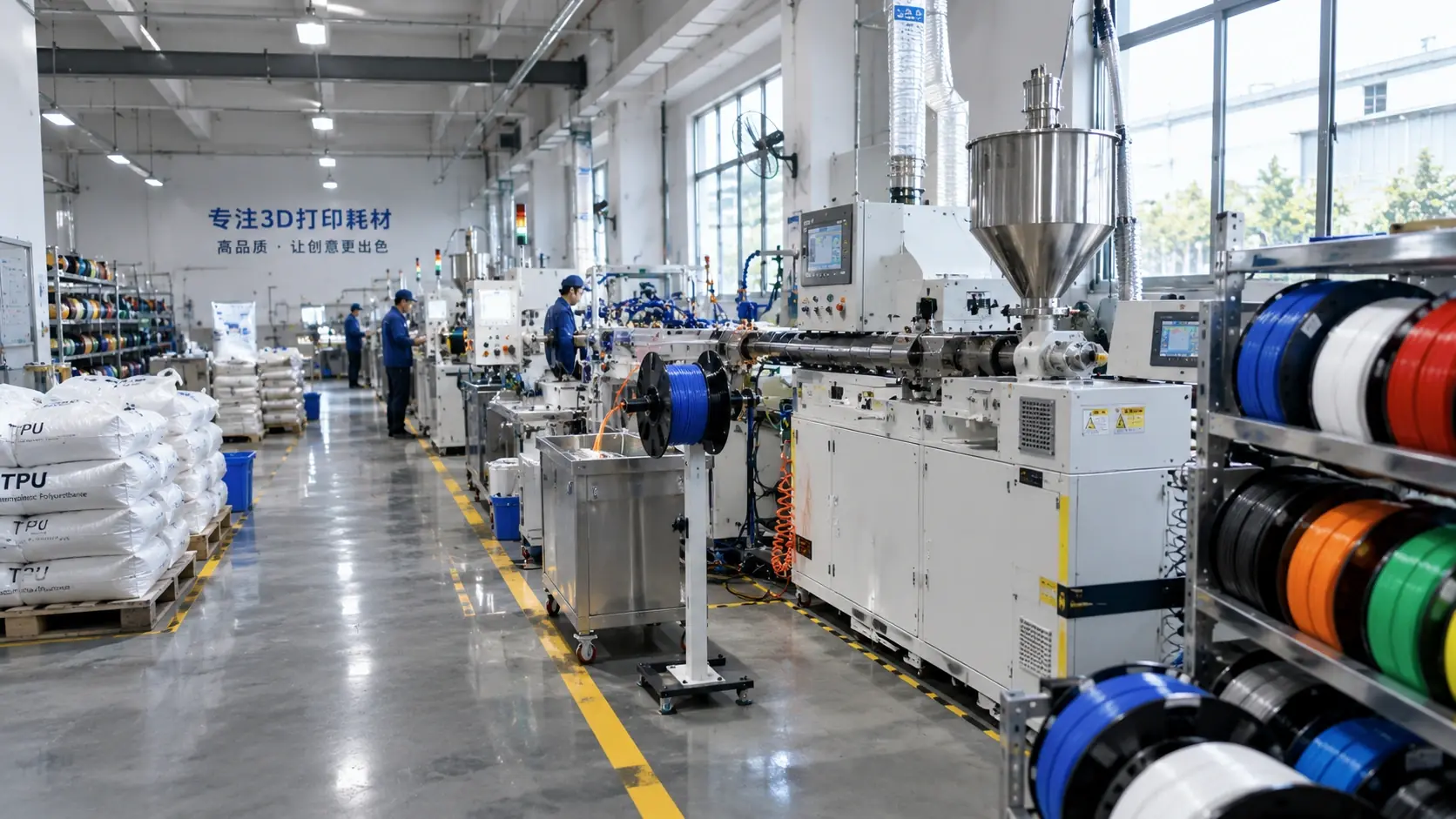
Filament manufacturing converts polymer pellets into a controlled 1.75 or 2.85 mm strand, then cools, measures, winds and packs it. Diameter, colour, moisture and mechanical performance are built into every step.
Raw material and drying
- Incoming pellet inspection
- Moisture control
- Colour and additive dosing
- Blending and mixing
Extrusion and inline measurement
The extruder melts and mixes the compound. After the die, cooling and haul-off set the diameter, while a laser gauge continuously monitors average diameter and ovality. The line adjusts haul-off and tension from that data.
Winding and packaging
- Tension-controlled winding
- Traverse layout
- Weight check
- Vacuum packing and desiccant
Testing and traceability
Tensile, impact, density, moisture and print tests confirm the batch. The spool can be traced back to raw material, machine, shift and inspection records.
| Stage | Key control | Record |
|---|---|---|
| Raw material | Lot and moisture | Supplier and batch |
| Compounding | Ratio and dispersion | Formula and test |
| Extrusion | Temperature, speed, tension | Machine parameters |
| Measurement | Diameter and ovality | Inline data |
| Packaging | Tension, drying, sealing | Weight and label |
Common engineering mistakes
- Buying only the extruder.
- Skipping drying and inline measurement.
- Ignoring wind tension.
- Not keeping retained samples.
- Tracing only the final product name.
Checklist
- Is raw material traceable?
- Is inline diameter recorded?
- Is wind tension stable?
- Is packing sealed and dry?
- Was print performance tested?
Discuss filament manufacturing and quality control through the quote form.